

How To Set Up Rfid System
Introduction
A few months agone I checked out a stack of books at our local library by placing the books on a kiosk. All 5 books magically appeared on the computer screen. Effectually the aforementioned time my male parent ran in the Bolder Bedrock, a foot race of over 50,000 people. An electronic system kept track of his time and thousands of others by merely having the runners wear paper race bibs. Pets that are found wandering can be identified and returned to their owners with a bones browse of the cervix. How is all of this possible?

The answer is RFID or Radio Frequency IDentification. This tutorial will embrace the basics of how RFID works, and will help guide you towards getting started with RFID.
Suggested Reading
If you aren't familiar with the following concepts, check out these tutorials earlier standing. They will help with the basic agreement of RFID.
- The Basics of Binary
- What is a Bombardment?
- Electric Power
Basics
Basic Functionality
It may be tempting to believe that RFID functions thanks to the reader module containing a very small hamster with x-ray optics, but in actuality, the organization is a chip simpler than that.
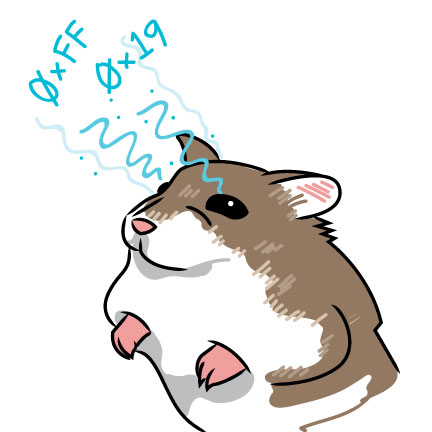
How RFID doesn't work
RFID uses radio waves produced by a reader to detect the presence of (then read the data stored on) an RFID tag. Tags are embedded in pocket-sized items like cards, buttons, or tiny capsules.
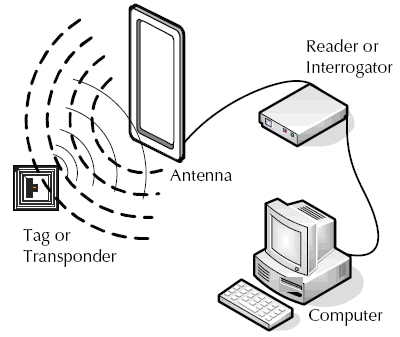
Image courtesy of EPC RFID
These readers also employ radio waves in some systems to write new information to the tags.
Types of RFID Systems
There are two types of RFID systems: passive or active. The tag power arrangement defines which type of system it is.
Passive
In a passive RFID organisation, the tags exercise not employ a battery; instead, they receive their energy to run from the reader. The reader emits an energy field of a few feet, providing the energy for any tag in the vicinity. The tag gathers the electromagnetic energy from the card reader, powers upward, and responds with 'hello world' and its identification information.
Passive tags take the benefit of being able to be read at a fast rate (10 or more times a 2nd). They are extremely thin (allowing them to be placed between layers of paper) and are extremely cheap (less than $0.05 in 10,000+pcs volumes).
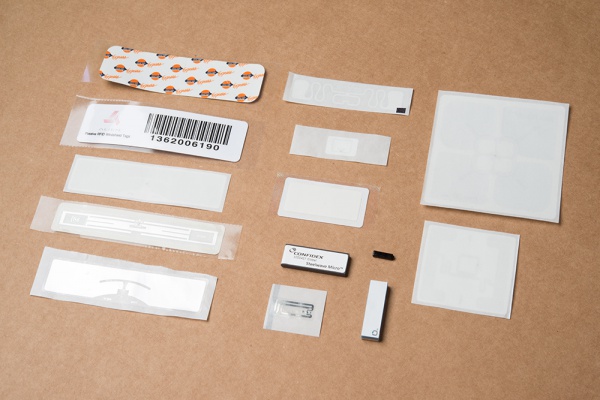
In full general, the smaller the tag the much shorter the read range
Active
Active RFID systems include tags that take their ain internal power supply for increased range. Active tags possess a battery and usually have larger SMD components. Afterward a preset amount of fourth dimension the tag emits an RF 'chirp'. A reader in the vicinity tin listen and hear for this chirp. Because an agile tag is they tin be read over much larger distances than passive tags (tens of feet).
Downsides to active tags include greater bulk (because of the bombardment), express life span (tag is dead when the battery is exhausted), increased toll per tag, and varying report rates.
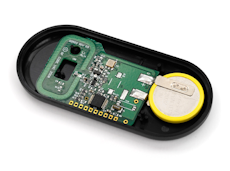
m130 Agile RFID asset tag from RF Lawmaking
RFID Frequencies
As well as active and passive systems, RFID systems can also be broken out into different frequencies.
Some frequencies and systems are designed to merely read ane tag at a time, while others tin read multiple. Toll of readers tin can likewise vary wildly based the frequency rating of the modules. In prior years a reader capable of reading multiple tags was in the thousands of dollars, sometimes tens of thousands. These systems were unattainable for most hobbyists and prototypers. However, this is finally beginning to change, and multi-read capable readers are becoming much more affordable.
Check out the post-obit chart for a basic intermission down of the frequencies, and their associated properties.
| A Few Common RFID Reader Types | |||||
|---|---|---|---|---|---|
| Frequency | AKA | Range | Read/Write | Read Multiple Tags Simultaneously | Boilerplate Tag Cost |
| Low Frequency (120-150 kHz) | "Chips/microchips" (in veterinary applications), prox cards, HID cards (both trade names) | Upwards to xx cm/ < one foot | Read But | No | $0.50 |
| High Frequency (13.56 MHz) | MiFare, NFC | Up to 1 meter | Read/write | No | $i |
| Ultra High Frequency (433 MHz, 860-920 MHz) | Long-range RFID, powered RFID | Upwardly to 100 meters | Read/write | Yes | $0.05 |
| Data from Wikipedia: Radio-frequency identification | |||||
Tag Memory
RFID tags store a lot of information in their memory - that's what makes them so useful. While in that location can exist many unlike types of identifying information stored in tags (which can vary from industry to industry), the majority of that is beyond the telescopic of this tutorial. Yous tin can observe more detailed data on tag storage requirements from the Tag Data Standard, and the Tag Data Translation Standard.
Some RFID tags (like the ubiquitous "HID ProxCard II" brand ID bill of fare and some brands of pet tag) use a proprietary format. School IDs and other cards from commercial access command systems may not work with all RFID readers.
Gen2 UHF RFID Retentiveness Standard
The v2.0.1 standard written by EPCglobal covers all RFID requirements for Gen2 RFID tags. Generally speaking, the memory of a tag is split into three: the TID, EPC, and User Memory.
Tag Identifier Retention
The TID or Tag Identifier is 20 bytes or 160 bits. These means there are 1,460,000,000,000,000,000,000,000,000,000,000,000,000,000,000,000 different possible tag IDs (1.46 * 1048). More there are atoms in the human trunk! Not quite the number of atoms in the universe. Every RFID tag has a unique TID. The TID is not editable.
Electronic Product Lawmaking Retentiveness
While TIDs are good for absolute identification the Gen2 RFID standard was actually created to replace the barcode in many retail environments. When you go to purchase your groceries the register doesn't care if you take detail TID 0xE242F3, it cares if you have a gallon of milk or a jar of peanut butter. That's where the Electronic Production Code (EPC) comes in: information technology's generally 12 bytes, user editable, and meant to be written to as a UPC type replacement. Slap an RFID tag on the gallon of milk, program the tag'due south EPC to be 0 7874203641 0 and the register will identify information technology as a half-gallon of Lactose Gratis one% Low Fat Milk made by Great Value (random source). The tag doesn't care what you write to those 12 bytes so writing ASCII RufusTheDog is perfectly acceptable but keep information technology below 12 bytes.
User Memory
The size of User Retention tin vary from 0 bytes to 64 bytes. The cheaper the tag the fewer bytes of user memory information technology will probable have. What practise you do with 64 bytes? To keep with the gallon-of-milk analogy, user memory was originally intended to tape things like expiration dates. The EPC is the global identifier ('this is milk'), and the User Memory was specific to that gallon ('sell by August 15th'). Again, the tag doesn't care so consider recording user setting information (this user enjoys a 10 degree decline in the pilot seat) or use the retentiveness as the world's smallest dead driblet.
Passwords
In that location are additional writable retentivity locations called the Admission password and Kill password. The Admission countersign can be used to prevent people from re-configuring tags ("it may expect like a sirloin steak merely the register says it's a pack of gum..."). The Kill password is used to permanently and irrevocably disable a tag.
Troubleshooting
Depending on the enclosure and environment you are operating an RFID system in, yous may run into functionality issues with the readers not accurately reading or writing data from a tag. Here are a few pointers to go along in listen that may help improve your organisation's functionality.
- Avert RF Interference - Whatsoever other RF-emmiting devices in the area of your organisation may negatively affect the performance of an RFID system, especially if they operate in the same band. Having multiple RFID readers virtually each other can cause system interference
- Utilise a clean ability supply - Similar almost electronic systems, noisy and/or dirty ability supplies tin cause strange behavior in an RFID arrangement. Clean, regulated power sources are recommended.
- Check for line of site - Open-air readings without other objects obstructing the line-of-site between the reader and the tag can ameliorate outputs.
- Use an external antenna - This can improve read range for all systems. Onboard antennas are express in power and range.
- Cease Holding Tags (UHF systems) - Humans are basically bags of water. If you hold the tag in your paw you lot'll degrade the range for reading significantly. Instead, record the tag to a non-metal, non-watery device.
- Change tag types - Typically, the smaller the tag, the shorter the read range. If y'all are using a glass capsule, try a push. If you're using a push, try a card.
Purchasing an RFID Arrangement
RFID kits, readers, and tags tin all help define or expand your projects. If you're looking for one to go started with, these are some of the options available.
UHF RFID Antenna (RP-TNC)
WRL-14131
This is your solution when y'all absolutely, positively demand to go the most out of an antenna for your next RFID project. This…
RFID Module - M6E-NANO
SEN-16887
M6E-Nano's wide RF output range (0 dBm to +27 dBm) is important for the read/write requirements for RFID-enabled printers a…
MIKROE RFID ii Click
WRL-19379
RFID 2 Click is a compact add-on lath that contains a stand-alone RFID reader with a built-in antenna easy-to-use for embedd…
Resource and Going Further
Now that you lot're familiar with the concept of RFID, it's fourth dimension to incorporate it into your ain project!
Check out these links for additional information regarding RFID:
- GS1'southward Electronic Product Codes/RFID Standards
- ThingMagic RFID
- IdentiSource Card Identifier Guide
- python RFID library and examples
Need some inspiration for your next project? Bank check out some of these related tutorials and weblog posts:
SparkFun Qwiic RFID-IDXXLA Hookup Guide
The Qwiic RFID ID-XXLA is an I2C solution that pairs with the ID-LA modules: ID-3LA, the ID-12LA, or the ID-20LA, and utilizes 125kHz RFID fries. Permit's take a look at the hardware used for this tutorial.
Build a Qwiic Jukebox that is Toddler Approved!
Follow this tutorial to build your ain custom jukebox. Note, this is designed uncomplicated and tough for use primarily with toddlers. Information technology'due south likewise a great introduction to SparkFun's Qwiic products!


How To Set Up Rfid System,
Source: https://learn.sparkfun.com/tutorials/rfid-basics/all
Posted by: addisonfaren1994.blogspot.com
0 Response to "How To Set Up Rfid System"
Post a Comment